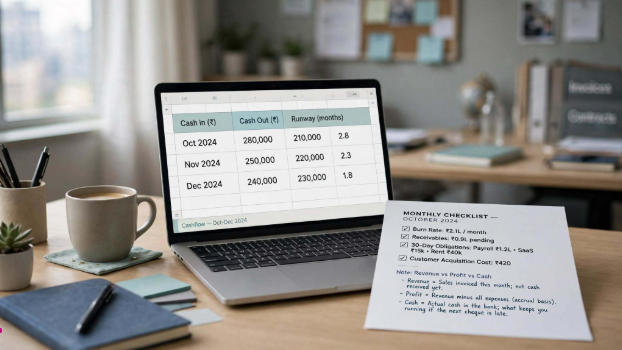
Here is a situation that plays out in some Indian startup every month. The business is doing well. Customers are happy, invoices are going out, the founder feels good. Then payroll week arrives, and there is ₹2 lakh in the bank against ₹9 lakh of invoices that clients have not paid yet. Nothing is wrong with the company. The money is just in the wrong place.
Cash flow is one reason any young companies can fail, though it gets “less attention” than valuations or funding rounds. Good “startup financial management” is about three things:
- how much cash you have,
- how fast you are spending it, and
- when you expect the next payment.
You don’t need a finance team for this. A spreadsheet will do, as long as you keep updating it.
Revenue, profit and cash are three separate things
Revenue is what you have billed. Profit is what is left once costs are paid. Cash is what you can spend today. A company can be growing and profitable on paper and still miss payroll, because customers pay late and suppliers will not wait.
Say you land a ₹12 lakh contract, deliver in March, and the customer’s terms are 60 days. March looks fantastic in your books. In your bank account, rent, developer salaries and GST all fall due before their money shows up. Anyone who sells to large companies knows how that feels.
Indian rules touch on this. Payments to micro and small suppliers are meant to be made within 45 days, and the tax code can deny a deduction to a buyer who pays later. If you buy from small vendors, find out how it applies to you. If you are the small vendor, it is a handy line to use on a slow-paying client.
Two numbers are worth carrying around in your head. Burn rate is the cash leaving each month. Spend ₹10 lakh, collect ₹4 lakh, and net burn is ₹6 lakh. Startup runway is how many months you last at that rate, so ₹54 lakh in the bank gives you nine. Nine months sounds like plenty. It is not, because raising money often takes six months or longer, and you don’t want to begin when the account is already thin. Start talking to investors while you still have a year left.
Picking a way to fund it
Good “startup funding strategies” begin with a blunt question: what are you actually building? A business that could reach ₹5 crore in revenue and stay healthy needs different money from one chasing a market of a hundred million people.
Bootstrapping means using your savings and money from customers to grow. You stay in control and quickly learn what customers are willing to pay for, since there’s no investor money to cover the shortfall.
The cost is pace and personal risk. It suits services, paid software and products that can sell from month one.
Angel investors invest their “own money” early, usually in small amounts. They decide quickly, and a good one can offer useful contacts and honest advice.
Still, you are selling part of the company, and sloppy terms in a first round can cause friction when bigger investors turn up.
Venture capital is built for companies that can get very large very fast. It brings real money and a network. It also means having a board, a growth schedule and an investor who needs a big exit to meet their own targets. If your company is doing well but isn’t likely to grow very large, this kind of deal may not work in your favour.
Then there is the money people forget: grants, government schemes, venture debt and revenue-based financing. None is free, and none is simple to win, but each can buy months of runway without handing over as much of the company.
The market matters here. Funding in India this year has gone to fewer companies in larger amounts, and seed rounds have been squeezed hardest. Investors want real revenue and straight answers about unit economics. Walking in with a clean cash flow forecast puts you ahead of most of the people they meet that week.
To keep an eye on which rounds are closing and on what terms, Malik Times Funding News follows the deals.
Financial planning for startups starts with a budget someone opens
Financial planning for startups doesn’t need a grand model. It needs a budget that gets opened on the same day every month.
Write down your operating expenses — salaries, rent, software, marketing, legal and accounting, taxes, and the small recurring charges — that nobody remembers until the card statement arrives. Split them into fixed costs, which stay put, and variable ones, which follow sales. Fixed costs are what hurt in a slow quarter.
Hiring is where budgets leak. A salary is only part of what a person costs. Add the employer’s contributions, a laptop, software licences, the manager’s time and the months before they are fully useful. Someone on ₹8 lakh a year can easily cost the company ₹10 lakh or more in the first year.
Next,
- Prepare a “cash flow forecast” for the next 12 months, one month at a time,
- Use the dates when you expect the money to reach your account, not the dates on you send invoices,
- Make three versions: your expected figures, a case where sales are 30 per cent lower or payments are delayed, and a good case.
Most importantly, you need to pay close attention to the “worst-case” version. It helps you see what needs to change before cash runs short.
And keep a cushion. Three months of fixed costs is a fair start, six is better. Holding cash back feels wasteful when growth is calling, right up until a large customer pays six weeks late.
Software helps, up to a point
You don’t need a finance department to see your numbers, but you do need a system. Cloud accounting tools bring in your bank transactions, match them to invoices, raise GST-compliant bills and show who owes what. You won’t have to keep reminding customers about “late payments” yourself if the tool sends reminders automatically. Some tools can also sort expenses using AI and point out spending that looks unusual. This can save a lot of time.
You need to check a few things before picking a tool.
- Does it work with your “bank” and invoicing software?
- Will it cost more when you add team members?
- And can you “download” your data if you decide to switch?
Your financial records contain private information — so it’s better to check who can see them and whether two-step login is available. Give each person only the access they need. Don’t run the company on one shared password.
A forecast on a tidy dashboard is still a guess. Treat it like one.
What goes wrong, over and over
Spending as if the next round is certain. Hiring ahead of revenue and moving to a bigger office feel like progress until the round slips by a quarter.
Being too optimistic with “forecasts”. Sales can take longer, customers may pay late and costs can also go up. It’s better to plan with lower numbers and be glad if things turn out better than expected.
Scaling before the basics work. A second city or a doubled team, before the first customers are happy and the margins make sense, only multiplies the problem you haven’t solved.
Depending on one investor or customer too much. If one source pays for half your costs, they end up deciding your timeline.
Mixing personal and business money. Open a separate account on day one. Your accountant, and any future investor, will thank you.
Not looking at the numbers. Plenty of founders check the bank balance and nothing else. That says where you stand today, not where you are heading.
A monthly check, two hours at most
On the last working day of each month, go through these:
- How did actual cash in and out compare with the forecast, and why?
- What are burn and runway now?
- Who owes us money, and how overdue is each invoice?
- What do we owe in the next 30 days, including GST, TDS and salaries?
- What did each new customer cost to win, and what will they bring in over time?
- Are sales growing, and is the “gross margin” still holding up?
- Looking at the next “twelve” months, will you need to raise money or cut spending?
If you only keep one, keep the last.
For more on how Indian startups raise, spend and grow, you can follow Malik Times Startup News, Malik Times Business News and the wider coverage on Malik Times at https://maliktimes.in/.
What lasts
Money doesn’t make a business sustainable. Good “habits” do. The founders who last tend to know their runway without checking, treat funding as a tool and not a prize, and decide how fast to grow with numbers on the table. None of it is exciting. All of it works.
Build the company so that if the next cheque turns up late, it is still standing. That is what sustainable startup growth looks like on an ordinary Tuesday.
This article is for “general information” only and it should not be considered a financial, tax or legal advice. Rules on payment terms, taxes and funding schemes change, so speak to a qualified accountant or adviser before making decisions.